The Collaborative on Inclusive Entrepreneurship Education and Training

CIEET

The WEIForward Collaborative on Inclusive Entrepreneurship Education and Training (WEIForward-CIEET), originally launched as a community of practice, has been re-branded and re-focused on the development of a systems and intersectional approach to inclusive entrepreneurship education and training (IEET) for women and youth.

What is the Collaborative for Inclusive Entrepreneurship Education & Training?

The CIEET brings together academics and practitioners engaged in designing and delivering EET. Our collective goal is to increase the inclusivity of the concepts, content, and delivery of EET to benefit learning and practice in order to increase the benefits of entrepreneurial activity for economic growth and sustainability.

Who joins the CIEET:
Academics
Instructors & Trainers
Program Managers
Policymakers
Funders
Women's Enterprise Advocates

The CIEET will be hosted on an interactive, virtual platform designed to facilitate communicationconnectioninnovationlearning, and knowledge sharing on inclusive EET.

Why Inclusive EET Matters

One of the principal pillars of WEIForward’s strategy is to support the development of deeper pipelines of transformational women-owned and youth-owned enterprises in the ‘missing middle’.

Structural Barriers & the Role of IEET

Women and youth who pursue entrepreneurial opportunities encounter structural and systemic biases that limit the development, scaling, and survival of their business ventures. They are generally constrained to smaller, less profitable, and slower-growing businesses than comparable ventures owned by men. The COVID-19 pandemic has exacerbated these challenges for female-led businesses.

Education is an essential driver for economic empowerment. Inclusive entrepreneurship education and training (IEET) offers an important lever for scaling the development and delivery of business competency skills, experiential learning opportunities, and networks for women’s entrepreneurship. WEIForward advocates for IEET targeting women and youth at the secondary and tertiary levels of education to help #BreakTheBias.

A group of young adults engaged in a lively discussion around a table, with bookshelves filled with various books in the background.

Overarching Goal of WEIForward-CIEET

We apply a systems and intersectional approach to achieve the following:

1

Knowledge Sharing & Learning

Facilitating knowledge sharing, shared learning, and information dissemination across the ecosystem.

2

Strengthen Design & Delivery

Strengthening the design and delivery of IEET courses and programs for greater impact.

3

Reduce Bias & Stereotypes

Reducing gender, ethnic, and occupational stereotypes and systemic biases that inhibit women’s entrepreneurship.

4

Build Coalitions

Building coalitions of policymakers, academics, practitioners, funders, and women and youth enterprise organizations to design and advocate for innovative solutions to addressing bias in EET.

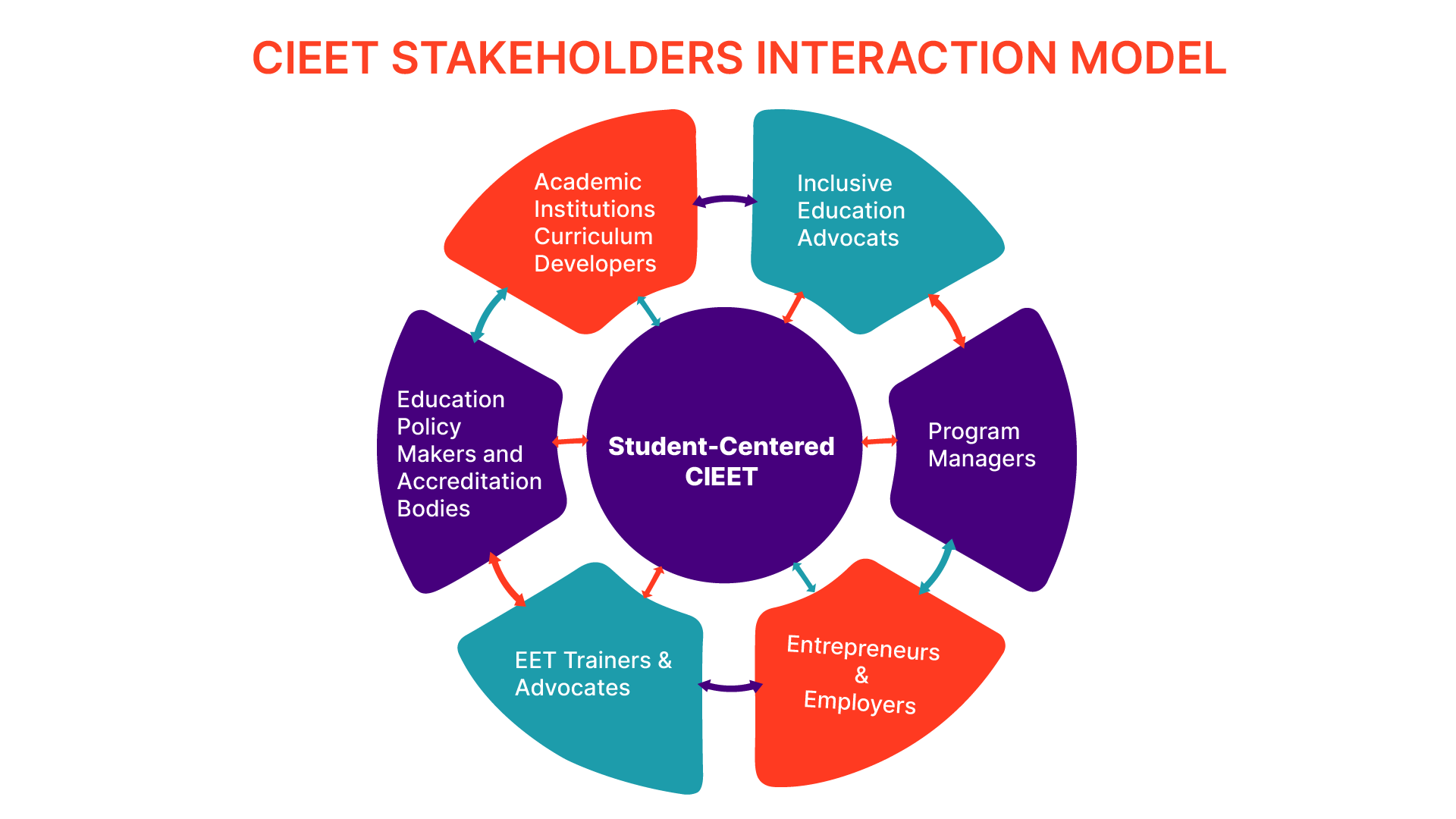
A diagram illustrating the Student-Centered CIET model, detailing various roles and stakeholders involved in educational development and advocacy.

CIEET Focus Areas at a Glance

Knowledge sharing & dissemination
High
IEET design & delivery
High
Reducing bias in EET
High
Coalition building & advocacy
High

From Barriers to Impact: How IEET Works

Structural & systemic barriers

Bias, norms, access to capital, networks

IEET as a lever

Inclusive concepts, content & delivery

Structural & systemic barriers

Bias, norms, access to capital, networks

GEET+ Pilot: Key Findings & Takeaways

Insights from the Gender-smart Entrepreneurship Education & Training Plus (GEET+) pilot

1

Awareness & interest

The GEET+ Scorecard raised awareness and stimulated respondents’ interest in learning about inclusive EET. There is scope to adapt and integrate assessment tools such as the GEET+.

2

Tool design challenges

The tool presented challenges related to design, criteria, targeting, and performance metrics that need to be addressed in future iterations.

3

Complex ecosystems

Entrepreneurial ecosystems are complex, encompassing social, economic, and cultural factors that constitute enablers, inhibitors, and actors specific to each country’s institutional framework and context.

4

Context-specific strategies

Strategies to address drivers and inhibitors of inclusive EET must be adapted to a range of context-specific factors: norms, institutions, structural and systemic barriers, and multi-level organizational frameworks.

5

Defining inclusive EET

Many organizations within the ecosystem face challenges in defining and operationalizing inclusive EET. There is a need to improve the design, content, and delivery of EET programs to benefit diverse constituents.

6

Incentivize change

Mobilize support for inclusive EET, manage risks and rewards, and incentivize change across the ecosystem.

Ecosystem insight: These ecosystems encompass systemic factors that influence women’s entrepreneurship. Strategies must be adapted to address context-specific factors including norms, institutions, and structural barriers.

Publications and Resources

Access our latest research, reports, and tools that drive evidence-based policy and practice

GEET Pilot Study Synthesis Report

The pilot study examines the adaptability and applicability of the Gender-smart Entrepreneurship Education and Training Plus (GEET+)1 scorecard.

Kenya GEET+ Pilot Study Report

The GEET+ Action Strategy is motivated by several observations. First, women entrepreneurs make significant contributions to economic growth

Mexico GEET+ Pilot Study Report

In an environment as diverse as Mexico, and where entrepreneurs and the private sector have been heavily impacted by the economic contraction

Nigeria GEET+ Pilot Study Report

The main objective of the GEET+ is to investigate the extent to which Nigeria’s system of entrepreneurship education
and training is women-friendly.

Lagos Business School GEET Report

Nigeria is the most populous African nation with a population of more than 215.1 million people.

Peru GEET+ Pilot Study Report

The GEET+ scorecard is an assessment tool that translates academic research and evidence-based insights into practical applications

GEET+ Summary of findings and Recommendations

Entrepreneurship education is associated with business start-ups, enhancing entrepreneurial competencies, increasing confidence or self-efficacy, and informing opportunity identification.